

Why do investors keep asking if they should be cashing part of their RRSPs to fund TFSAs as a way to avoid paying taxes at a later date?
It’s one of the most common questions we hear – and one of the most misunderstood issues we encounter.
A Brief History of the RRSP
The Registered Retirement Savings Plan was introduced in Canada in 1957 to give self-employed individuals and those without a company pension the same tax advantages already available to members of employer-sponsored pension plans.
Brought in by the Liberal government under Louis St. Laurent, the plan was originally called a Registered Retirement Annuity. Contributions were capped at $2,500, or 10% of the previous year’s earned income, and unused room could not be carried forward to future years. The government didn’t begin tracking contribution data until 1968, and uptake was slow at first – only about 179,000 Canadians participated in that first recorded year. Measures like the Spousal RRSP and the RRIF came later, as the program matured.
Over the following decades, the RRSP grew into a cornerstone of Canadian financial planning. Today, it remains one of the most effective tools available for reducing taxable income while building retirement savings.
Why RRSP Redemptions Are So Widely Misunderstood
After talking to investors for years, we are still struck by how many people, even long-time RRSP contributors don’t fully understand how the plan works, once money starts coming out of the plan. Almost everyone can explain the deduction mechanism: contribute, lower your taxable income, get a refund (or reduce taxes owed). But ask about redemptions, tax implications, or how an early withdrawal affects retirement income down the road, and the understanding tends to fall apart.
Early withdrawals are strongly discouraged for three main reasons:
- An immediate tax hit. Withdrawals are treated as regular taxable income, and your financial institution withholds tax at the time of withdrawal: 10% on amounts up to $5,000, 20% between $5,000 and $15,000, and 30% on anything over $15,000. If your marginal tax rate is higher than the withheld amount, you’ll owe the difference when you file your tax return.
- Permanent loss of contribution room. Unlike a TFSA, where withdrawn amounts are added back to your room the following calendar year, RRSP contribution room you clear out by withdrawing is gone for good.
- Lost compound growth. Every dollar you take out is a dollar that no longer grows tax-deferred until you actually need it in retirement.
Before redeeming money from your RRSP, pause and get professional advice that reflects your full tax and retirement picture. It may feel like a simple solution today, but once the funds are withdrawn, the contribution room is permanently lost, and the long-term impact on your retirement can be difficult to recover from.
What the Math Actually Shows
To see what that lost growth looks like in real dollars, consider a simplified example: a one-time decision to redeem $10,000 from an RRSP and invest the net proceeds in a TFSA instead.
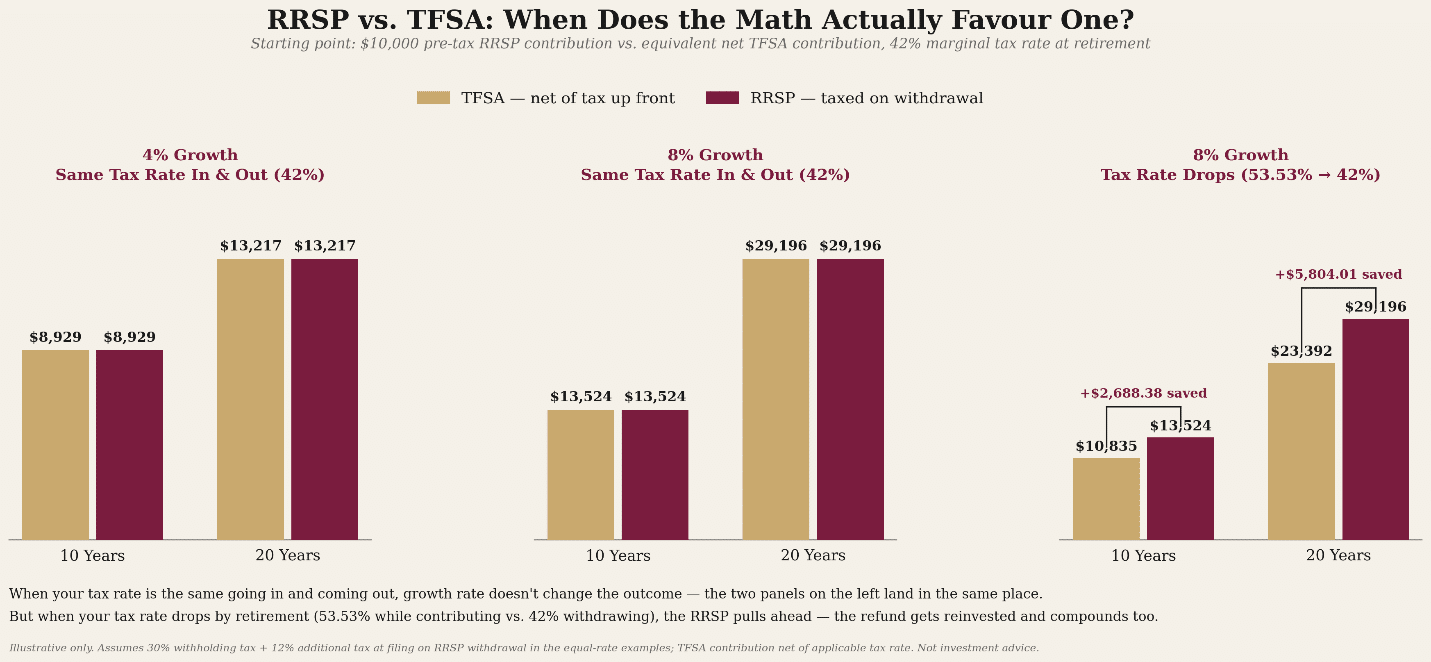
As the chart shows, when your tax rate is the same going in as it is coming out, the growth rate you earn, doesn’t actually change the outcome, an RRSP and a TFSA land in exactly the same place. But that’s rarely how real life plays out. When your tax rate is meaningfully higher during your working years than it will be in retirement, as in the third example, where as an example a 53.53% marginal rate today drops to 42% at withdrawal, the RRSP pulls ahead. That number only increases if your marginal tax rate is lower than 42%.
It’s also worth remembering that this example assumes a single, one-time decision. In practice, moving RRSP proceeds into a TFSA uses up valuable TFSA contribution room – room you won’t get back until the next calendar year, and room you may wish you still had if you’re already maxed out and come into more money to invest.
The Bottom Line
The math can genuinely favour an RRSP withdrawal in the right circumstances, but “the right circumstances” is doing a lot of work in that sentence. It depends on your current tax bracket, your expected tax bracket in retirement, your available TFSA room, and how many times you’re tempted to repeat the exercise.
Before you act on it, talk to a professional who can look at your full picture – not just the withholding tax on the statement.